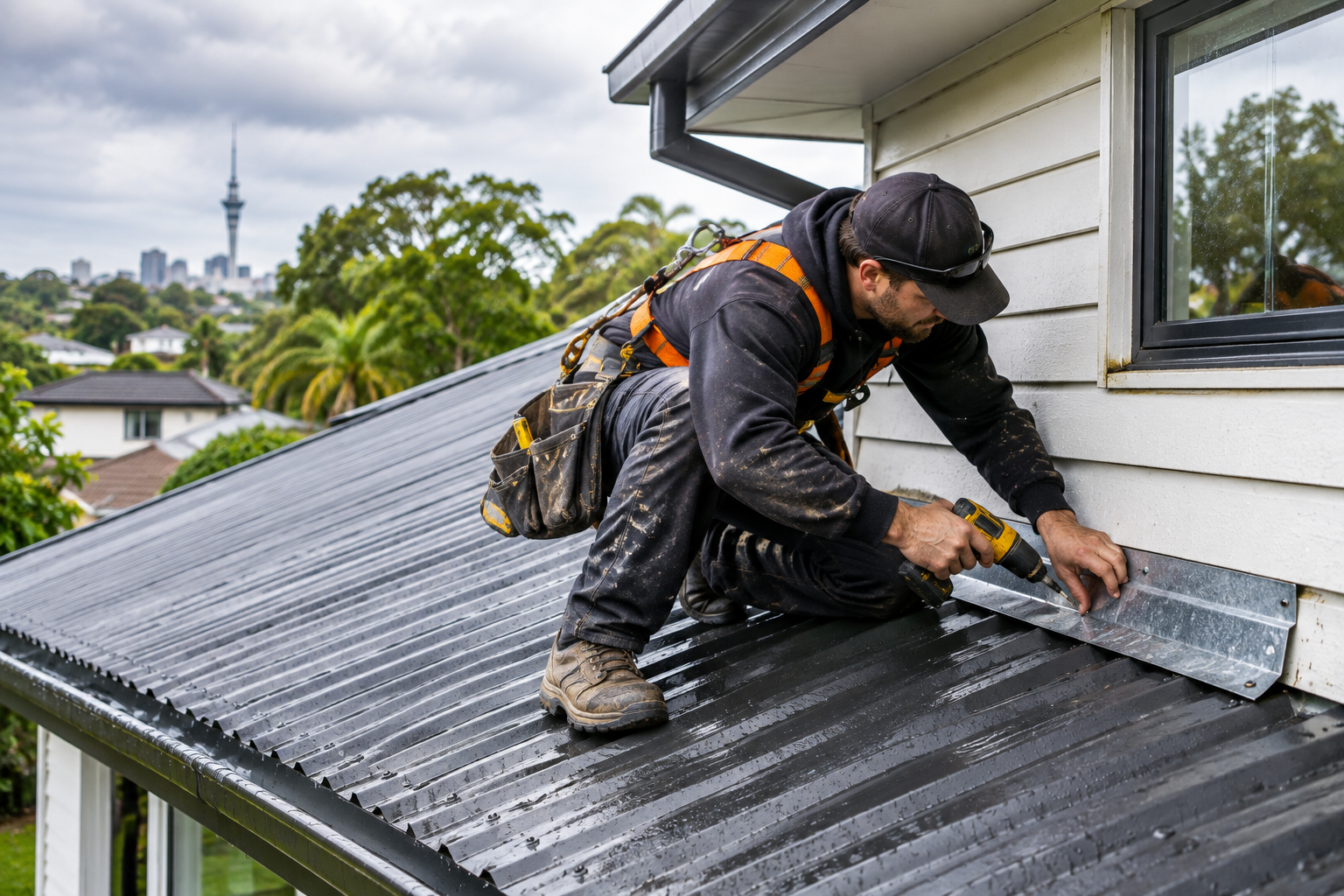
Roof Leak Repair Auckland: How to Find the Source and Fix It
- Home
- Roof Leak Repair Auckland: How to Find the Source and Fix It

Our Blogs
Nobody notices a roof until it lets water in. One minute it is a dull Tuesday, the next there is a brown ring spreading across the bedroom ceiling and a bucket catching drips that seem far too loud at 2am. If that is where you are right now, the first thing to know is that roof leaks are fixable, and the sooner you act, the smaller the repair usually is.
This guide covers roof leak repair Auckland homeowners and property managers need to know: what to do in the first half hour, why finding the real source of a leak is harder than it looks, what typically causes leaks in Auckland’s climate, how professionals repair them properly and how to stop them coming back. Everything here is written to be practical, so you can use it whether the water is coming in now or you are just trying to be prepared.
If water is coming through your ceiling, take these steps before you do anything else. They limit the damage while you arrange a proper repair.
For a fuller walkthrough of the urgent steps, see our guide on what to do first in an emergency roof repair situation in Auckland.
The most frustrating thing about a leaking roof is that the stain on your ceiling is rarely directly under the hole in the roof. Water behaves in ways that surprise people.
Water travels. Once it gets through the roofing, it runs along the underlay, down rafters, along battens and across the top of the ceiling lining before it finally drips somewhere. The entry point can be a metre or more away from where you see the stain.
Leaks can be intermittent. Some leaks only appear when rain comes from a particular direction, or when the wind pushes water uphill under a lap or flashing. You can have a dry roof for weeks and then a leak during one storm.
Damage can be slow and hidden. Small leaks can soak insulation and timber for months before a stain shows up, which is why a leak that “appeared suddenly” is often an old problem that has finally broken through.
Condensation can look like a leak. In a humid climate like Auckland’s, moisture forming on the underside of roofing and dripping back down can mimic a roof leak. We cover how to tell the difference below.
This is why a good roofer does not simply put sealant over the stain. They trace the water back to its source, fix that, and then check that the fix worked.
Auckland’s heavy rain, wind, humidity, coastal salt and strong UV all work on a roof year-round. These are the usual suspects when a leak appears.
Flashings seal the junctions where the roof meets something else: chimneys, skylights, vents, pipes, walls and valleys. They are among the most common leak points on any roof. Over time they can lift, crack, corrode or lose their sealant, and wind-driven rain finds the gap.
On metal roofs, screws and fixings can back out, corrode or lose their washers. That lets water seep in around each fixing. On tile roofs, broken clips and slipped tiles can leave gaps.
Tiles can crack from impact, age or foot traffic, and they can slip after storms. A single broken tile can let enough water through to cause real damage underneath.
Rust at cut edges, laps and fixings can eat through metal over time, especially near the coast. Dents, lifted sheets and damaged coatings can also let water in.
Valleys carry a lot of water, so any weakness there shows up quickly. Ridge and hip capping on tile roofs relies on bedding and pointing that can crack and crumble.
Overflowing gutters push water back under the roof edge and into fascia and soffits. Sagging gutters and bad joins send water where it should not go.
Anything that pokes through the roof, such as vents, flues, aerials and solar mounts, relies on sealant and flashing that ages in the sun and weather.
Roofs wear out. After years of UV, rain and wind, even a well-built roof can develop multiple small failures. If you are repairing the same roof repeatedly, that is a sign to think about the bigger picture.
Our guide to common roofing problems in Auckland homes and how to fix them shows what each of these looks like in practice, and our article on how Auckland’s weather affects roof damage and repairs explains why local conditions are so hard on roofs.
Before you call anyone, it helps to know which problem you probably have. Condensation is surprisingly common in New Zealand homes and is often mistaken for a roof leak.
| Clue | More likely a roof leak | More likely condensation |
|---|---|---|
| When it happens | During or soon after rain | On cold mornings or humid days, even without rain |
| Where it shows | A single spot, often with a stain ring | Across larger areas, windows, corners and cold surfaces |
| Water appearance | Clear or brown, drips from a point | Fine droplets, damp patches, mould spotting |
| Roof space | Wet timber or insulation in one area | Damp underside of roofing across a wide area |
| Pattern | Follows the weather direction | Follows temperature and humidity |
Both can exist at once. A roof space with poor ventilation and a small leak can make both problems look like one. A professional inspection can separate them, and the fixes are quite different: condensation is solved through ventilation, insulation and moisture control, while leaks are solved through repair.
You do not need to find the leak yourself, but a bit of safe detective work gives a roofer useful information and helps you describe the problem accurately.
If you can access the roof space safely on a dry day, take a torch and look for:
Move carefully and only step on beams or proper walkways, not on the ceiling lining. If the space is cramped, hot or unsafe, skip this step.
Climbing onto the roof to look for the leak is a common way homeowners get hurt. Roofers use safe access, edge protection and often controlled water testing to track a leak to its source. That is the safest and most reliable way to confirm it.
A proper repair follows a sequence. Knowing it helps you judge whether a contractor is doing the job properly.
The roofer inspects the roof surface, flashings, penetrations, valleys, gutters and the roof space. They work backwards from the stain to the likely entry point and look for secondary damage along the way.
Where the cause is not obvious, a roofer may do controlled water testing, working section by section to find where water gets in. This takes patience, but it is the difference between fixing the leak and covering it up.
You should receive a clear written explanation of what caused the leak, what will be done and what is included. If hidden damage is found once work begins, the contractor should explain it and agree any extra work with you first.
The team sets up safe access, protects the property and checks the weather. Roof work is done in suitable conditions, so a good contractor will reschedule instead of rushing a repair in the rain.
The actual fix depends on the cause. It can include replacing broken tiles, re-fixing or replacing metal sheets, renewing flashings, re-bedding and pointing ridge capping, replacing corroded fixings, resealing penetrations or repairing gutters. Where moisture has damaged underlay or timber, that is dealt with before new material goes over the top.
Once the repair is complete, the area is checked for watertightness. A professional checks their own work, cleans up and walks you through what was done. Ask for photos, especially of anything that will be hidden afterwards.
If you want to see what this covers, our roof repair service handles leaks, flashings, fixings and storm damage across Auckland.
When the weather is bad and a leak is active, a temporary fix may be the sensible first step. It is important to know what it is and what it is not.
Temporary fixes include tarping a damaged section, applying emergency sealant or fitting a temporary covering. Their job is to stop water getting in until the proper repair can happen safely.
Permanent repairs address the cause of the leak: the failed flashing, the broken tile, the corroded sheet, the missing fixings. They are done in suitable conditions, with the right materials and a guarantee.
The trap is treating a temporary fix as the solution. A bead of sealant over a stain might hold for a few weeks, but if the real problem is a lifted flashing or a failed lap, the leak will come back, often in the next big storm. If someone offers a quick sealant fix with no inspection, be cautious.
Different roofs leak in different ways.
Common leak points include backed-out or corroded fixings, failed sealant at laps, rust at cut edges, damaged flashings and lifted sheets. Many metal roof leaks can be fixed without replacing whole sheets if they are caught early.
Typical problems are cracked or slipped tiles, deteriorated ridge bedding and pointing and degraded valley flashings. Because tile roofs rely on the underlay as a second barrier, leaks can also come from damaged underlay after a tile has failed for a while.
Leaks usually come from ponding water, split seams, failed upstands or poorly sealed penetrations. These roofs need careful drainage checks, and small defects can spread quickly.
Not part of the roof surface, but blocked or leaking gutters and rotting fascia are frequent causes of water damage that looks like a roof leak.
Sometimes a leak is a symptom of a bigger problem. Think about re-roofing or replacement when:
If the structure underneath is still sound but the roofing surface is worn out, re-roofing may be a more sensible path than repeated patching. If damage is widespread or the structure is compromised, a full roof replacement is usually the safer option. Our comparison of roof repair vs replacement for Auckland homeowners helps you decide which applies to you.
Fixing the leak is the first half. The second half is dealing with what the water did while it was getting in.
It depends on the cause and your policy. Sudden damage from a storm or falling object is often treated differently from damage caused by wear, age or lack of maintenance. General steps that help:
This is general information, not advice on your specific policy, so check the details with your insurer.
Prevention is far cheaper than repair. A few habits make a big difference in Auckland’s climate.
Inspect regularly. A professional inspection every one to two years, and after major storms, catches small faults before they become leaks. Our guide on how often you should inspect your roof in New Zealand explains how to time them.
Keep gutters and valleys clear. Blocked drainage is one of the easiest leak causes to prevent.
Deal with small problems early. A lifted flashing or a few loose fixings are quick to fix, but the same faults left through a wet winter can lead to much bigger repairs. Our article on the warning signs that you need immediate roof repair in Auckland lists what should never wait.
Plan repairs around the seasons. Dry periods are ideal for roofing work. Our guide on how often to schedule roof repairs in Auckland’s climate explains how to plan it.
Trim overhanging branches. They drop debris, hold moisture and can damage the roof in storms.
Rinse off salt and dirt gently. Avoid aggressive pressure washing, which can damage coatings and force water under laps.
A repair is only as good as the person doing it. Look for:
Be cautious of pressure to decide immediately, cash-only demands, large upfront deposits, unsolicited door knocking after storms and vague answers about what went wrong.
Leaks matter on every kind of property, though the stakes differ. For homes, the priority is protecting ceilings, insulation, belongings and the family’s comfort. For businesses, a leak can mean damaged stock, tenant complaints, safety hazards and downtime, so speed and drainage design matter more.
Our team handles both residential roofing and commercial roofing leaks across Auckland, from a single failed flashing to large flat roof drainage problems.
Metal Staff Roofing has more than 25 years of experience repairing roofs across Auckland. Our licensed roofing specialists focus on finding the real cause of a leak and fixing it properly, not just covering the stain.
What you can expect from us:
Dealing with a leak right now? Request a free quote or call us on +64 2108995040.
How do I find where my roof is leaking?
Start inside by noting where the stain or drip is, then check the roof space on a dry day for wet timber, damp insulation and staining. Remember that water travels, so the entry point can be some distance from the stain. A roofer can trace the source safely and confirm it, sometimes with controlled water testing.
What causes a roof to leak?
Common causes include failed or lifted flashings, loose or corroded fixings, cracked or slipped tiles, rusted metal sheets, damaged valleys and ridges, blocked gutters, worn sealant around penetrations and general age. Often a leak is a combination of small faults.
Can a leaking roof be repaired without replacing the whole roof?
Usually, yes. If the leak comes from a specific failure and the rest of the roof is sound, a targeted repair is normally enough. Replacement is only needed when damage is widespread or the roof has reached the end of its life.
Is it safe to fix a roof leak myself?
Ground-level tasks like clearing gutters are reasonable, but climbing onto a roof is dangerous, and DIY patches often hide the leak or cause more damage. Leave roof work to licensed professionals.
How quickly should I get a roof leak repaired?
As soon as you reasonably can. Water keeps causing damage to insulation, framing and ceilings every time it rains, and the longer it continues, the bigger the repair tends to be. For active leaks, ask about emergency availability.
Will a roofer come out in the rain?
Many companies can respond to urgent leaks with a temporary fix to stop water entering, even in poor weather. A proper repair is done once conditions are safe and suitable.
Why does my roof only leak in heavy rain or strong wind?
Wind-driven rain can push water sideways or uphill under laps, flashings and tile edges that stay dry in normal rain. Leaks that appear only in certain weather often point to a gap in a flashing, lap or junction on that side of the house.
Does insurance cover a leaking roof?
It depends on the cause and your policy. Sudden storm damage is often treated differently from wear and tear or poor maintenance. Photograph the damage, keep receipts and speak to your insurer early.
How do I know if it is a leak or condensation?
Leaks usually appear during or after rain in a specific spot, often with a stain ring. Condensation tends to appear on cold or humid days across larger areas and on cold surfaces. A professional inspection can separate the two, and they need different fixes.
What should I do while waiting for the roofer?
Contain the water with buckets, protect belongings, turn off power if water is near electrics, photograph everything and avoid climbing onto the roof. Keep the area clear so the roofer can work safely when they arrive.