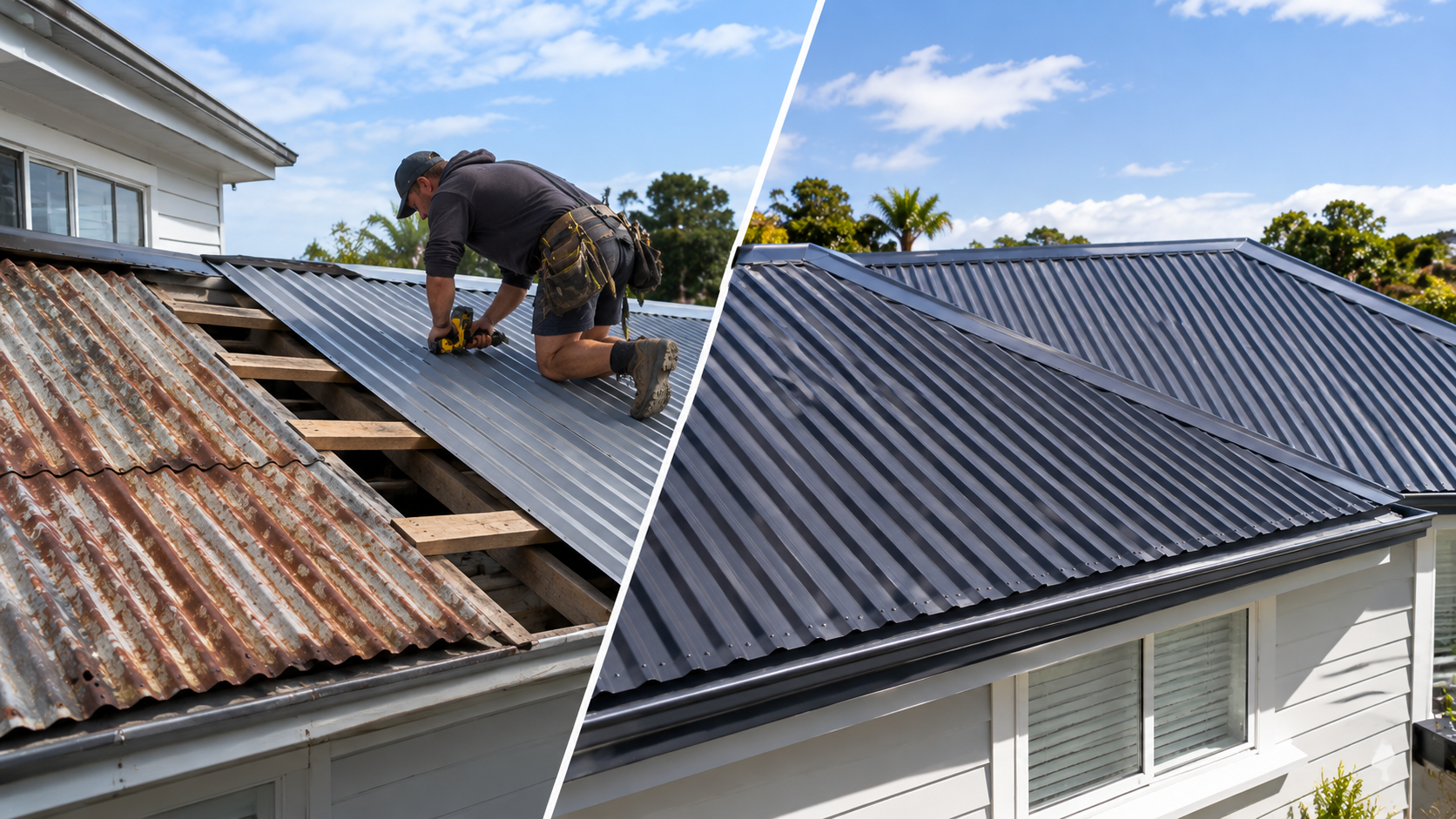
Re Roofing Auckland vs Full Roof Replacement: Which One Do You Need?
- Home
- Re Roofing Auckland vs Full Roof Replacement: Which One Do You Need?

Our Blogs
When an Auckland roof starts to fail, most homeowners hear two terms from contractors: re-roofing and roof replacement. They sound similar, they are often used loosely, and choosing the wrong one can mean paying for work you did not need or, worse, covering up problems that come back a few years later.
This guide explains the real difference between the two, compares them side by side, shows when each one makes sense for an Auckland home and covers what drives the cost gap so you can read your quotes with confidence.
Re-roofing means giving your roof a new surface while keeping the structure underneath. The existing framing, battens and general roof shape stay in place, and new roofing material is installed to restore weather protection. Depending on the condition of the roof, this can involve installing new material over the existing roofing or removing the old surface and fitting new material onto the retained structure.
The idea is simple: if the bones of the roof are sound and only the outer layer has worn out, you do not need to rebuild the whole thing. Re-roofing focuses spending on the part that has actually failed.
You can read more about how this works on our re-roofing service page.
A full roof replacement removes the existing roofing and goes further. The old material is stripped off, the structure underneath is inspected, and any damaged timber, underlay or framing is repaired or replaced before a completely new roof system goes on.
This is the more thorough option. It lets the contractor deal with problems that are hidden under the surface, such as rotten battens, wet insulation or damaged rafters, and it gives you a roof that is new from the framing up. Our roof replacement service covers what this involves from start to finish.
In New Zealand, contractors do not always use these words the same way. Some use “re-roofing” to mean any new roof on an existing house, including a full strip-off. Others use it only for installing new material over a sound structure. Because of this, never rely on the label alone. Ask every contractor to describe exactly what will be removed, what will be repaired and what will be installed, and make sure the written quote says the same thing.
Here is how the two approaches compare on the points that matter most.
| Factor | Re-roofing | Full roof replacement |
|---|---|---|
| What changes | New roofing surface on a retained structure | Entire roof system renewed |
| Structure underneath | Must be sound | Inspected and repaired as needed |
| Hidden damage | Can be harder to find and fix | Exposed and dealt with during strip-off |
| Demolition and waste | Usually less | More |
| Disruption and timeline | Often shorter | Usually longer |
| Upfront cost | Often lower | Often higher |
| Best for | Worn surface, healthy framing | Widespread damage, compromised structure |
| Long-term reset | Partial | Full |
The headline takeaway is that re-roofing is the more economical route when conditions suit it, and replacement is the more thorough route when they do not.
Re-roofing is usually a good fit when most of these are true.
The structure is sound. Framing, battens and rafters are dry, straight and free of rot, with no signs of sagging.
The problems are on the surface. The roofing is worn, faded, corroded or past its best, but the damage has not spread into the structure.
The roof has no widespread moisture damage. Insulation is dry and ceilings are not repeatedly stained.
The existing roof can carry the new material. The framing can support the additional or replacement load without being overloaded.
You want to limit disruption and waste. Less demolition generally means less noise, less debris and often a faster job.
The roof is not repeatedly leaking in multiple spots. Isolated leaks can often be fixed as part of the re-roof, while widespread leaking points to deeper issues.
A good example is a roof that has served well for decades and now has faded, rusting or brittle roofing, but dry timbers and a solid structure underneath. Re-roofing gives that home a fresh weather-tight surface without paying for a full rebuild.
Our guide on the top signs you need a professional re-roofing company in Auckland lists the visible warning signs that point toward this option.
Replacement becomes the smarter investment when any of these apply.
There is widespread corrosion, cracking or deterioration. If the problem is across the whole roof rather than in patches, covering it up only delays the inevitable.
Moisture has reached the structure. Rotten battens, damp or mouldy insulation, stained rafters and soft timber all need to be exposed and fixed properly.
The roof is sagging or showing structural movement. A roof that is moving needs engineering-level attention, not a new surface.
Multiple layers already exist. Adding yet another layer on top of old ones can overload the structure and hide problems.
There are repeated leaks in different places. This usually signals system-wide failure rather than isolated faults.
You are changing the roof significantly. Switching from heavy tile to lightweight metal, changing the pitch or altering the roof shape generally calls for a full replacement approach and may involve engineering and consent.
Asbestos is involved. On older homes, roofing that contains asbestos must be tested and handled correctly, which often points toward a full, properly managed removal.
The roof is near the end of its life in every respect. If all of the system is tired, a staged approach may cost more in the long run than doing it once, properly.
Our comparison of roof repair vs roof replacement for Auckland homeowners is a helpful companion read if you are still deciding whether you need a major job at all.
Rather than quoting figures that vary from job to job, it is more useful to understand why the two options price differently. That way you can read any quote and know whether it makes sense.
Demolition and disposal. Full replacement involves stripping everything off and disposing of it. Re-roofing generally involves less removal, which reduces labour and waste costs.
Structural repairs. Replacement exposes the framing, so any rot, damaged battens or weak sections get repaired. That repair work adds cost but also adds long-term security.
Labour time. More stages and more work mean more days on site, and labour is one of the biggest parts of any roofing quote.
Materials. Both options need new roofing, flashings and fixings. Replacement may also need new underlay, battens and timber, depending on what is found.
Roof complexity. Valleys, hips, skylights, chimneys and multiple levels add flashing work and time to either option.
Access and safety. Steep roofs and tight sites need more safety equipment and handling time.
Consent and engineering. Changing materials, altering structure or working on a heritage property can add consent and engineering costs, and this is more common with full replacement.
Future costs. Re-roofing can cost less today but may leave hidden issues to deal with later. Replacement costs more today but can reduce the chance of repeat spending.
The cheapest quote is not always the best value. The right question is not which option costs less, but which option solves your roof’s actual problem for the longest time.
For a deeper look at pricing, our guide on what it costs to re-roof a house in Auckland and our 2026 Auckland roof replacement cost guide go into budgeting in detail.
Use this checklist before you speak to contractors. The more boxes you tick in the left column, the more likely re-roofing will suit you. The more you tick on the right, the more likely replacement is the right call.
Leans toward re-roofing:
Leans toward full replacement:
If your answers are mixed, that is normal. A proper inspection is what settles it.
Neither option can be chosen safely from the ground. The deciding factors, structural condition, hidden moisture, fixings and layering, are all things you cannot see from outside.
A thorough inspection should cover the roof surface, flashings, gutters and the roof space underneath, and it should end with clear photos and a plain-language recommendation. Our guide to roof inspections in Auckland explains how often to schedule them and what they usually involve.
Be cautious of any contractor who recommends a full replacement or a quick re-roof without going into the roof space. Both can be right, but neither can be proven right without looking.
Yes, it can. Auckland’s humidity, wind-driven rain, coastal salt and strong UV all accelerate wear, and they can hide moisture problems inside a roof for a long time. That is why a roof can look fine on the outside while the framing underneath is already damp.
In coastal suburbs especially, corrosion at fixings and edges is a major factor. If it has progressed beyond the surface, replacement may be the safer long-term option. Our article on why Auckland’s climate matters when choosing re-roofing covers this in more detail.
Consent requirements depend on what exactly you are doing, so treat this as general guidance and confirm with your contractor and Auckland Council before work begins.
A reliable contractor will tell you early whether consent applies to your job rather than leaving it for later.
Before committing to a big job, check whether a smaller one will do.
Roof repair. If damage is localised, such as a failed flashing, a handful of loose fixings or a few cracked tiles, a professional roof repair may be enough. Our article on how often to schedule roof repairs in Auckland’s climate can help you plan.
Maintenance and treatment. Cleaning, recoating and fixing small defects can extend the life of a roof that is still fundamentally healthy.
Staged work. On larger or more complex properties, some contractors can stage the work in sections, which can spread the cost.
Both options apply to homes and businesses, though priorities differ. Homeowners tend to prioritise appearance, comfort and long-term value, while commercial owners focus on minimising downtime, drainage performance and compliance.
Our team handles both residential roofing and commercial roofing projects across Auckland, and for new builds and extensions our new roofs service works from your plans.
Whichever route you take, the quality of the contractor matters as much as the choice between the two.
Our guide on how to choose the best re-roofing service near you walks through what to look for, and our article on the benefits of choosing the best re-roofing service in Auckland explains what good workmanship delivers over time.
Metal Staff Roofing has more than 25 years of experience helping Auckland homeowners and businesses choose and carry out the right roofing work. Our licensed roofing specialists inspect your roof properly, tell you honestly whether re-roofing or full replacement suits it and give you a clear written quote with no hidden extras.
What you can expect from us:
Not sure which option fits your home? Request a free quote or call us on +64 2108995040 and we will take a proper look at your roof.
What is the difference between re-roofing and roof replacement?
Re-roofing gives your roof a new surface while keeping the existing structure, whereas full roof replacement removes the old roofing and renews the whole system, including repairs to framing and underlay. Contractors sometimes use the terms differently, so always ask for the exact scope in writing.
Is re-roofing cheaper than a full roof replacement?
Usually, yes, because there is typically less demolition, less structural work and a shorter timeline. However, re-roofing only makes sense when the structure is sound, and if hidden damage is left in place it can cost more later.
How do I know if my roof can be re-roofed?
The structure underneath needs to be dry, straight and free of rot, and it must be able to carry the new roofing. A professional inspection of the roof space is the only reliable way to confirm this.
Can new roofing go over my existing roof in New Zealand?
In some cases, yes, when the existing material and structure are suitable and the work meets building requirements. A contractor should inspect the roof and confirm compliance before recommending it.
When is full roof replacement the better option?
Replacement is usually better when there is widespread corrosion, rotten timber, repeated leaks in several areas, sagging, multiple existing layers or a planned change of material or roof design.
Do I need building consent for re-roofing or roof replacement in Auckland?
Like-for-like work often does not need consent, but changing the material, altering the structure or working on a heritage property can. Your contractor should confirm this before work starts.
How long does re-roofing take compared with replacement?
Re-roofing is often quicker because there is less to remove and repair, but timelines depend on roof size, complexity and weather. Your contractor should give you a realistic schedule in the quote.
Will a new roof improve my home’s value?
A sound, well-installed roof removes a major concern for buyers and improves curb appeal, whichever option you choose. Our article on why a new roof adds value to your Auckland home explains how.
Should I repair my roof instead?
If the damage is limited to a few areas and the rest of the roof is healthy, repair is usually the most economical choice. If you are repairing the same roof every year or two, a re-roof or replacement is likely better value.